
Press Releases

Cardlytics Appoints Karim Temsamani Chief Executive Officer
Lynne Laube to Retire, Serve as Strategic Advisor During Transition
ATLANTA, July 20, 2022 -- Cardlytics, (NASDAQ: CDLX), an advertising platform in banks’ digital channels, today announced that its Board of Directors has named Karim Temsamani as Chief Executive Officer of the company, effective September 1, 2022. Temsamani will also be joining the Board of Directors. He will succeed co-founder and current CEO, Lynne Laube, who has announced her intention to retire. Laube will continue to serve on the Board until its 2023 annual meeting of stockholders and will remain a strategic advisor until May 2024 to ensure a smooth transition.
Temsamani joins Cardlytics from Stripe where he most recently served as Head of Global Partnerships. Prior to that role, he served as Head of Banking and Financial Products, leading the strategic vision and execution across product and engineering, including Stripe Treasury, Issuing, Capital and Connections. Preceding Stripe, Temsamani spent nearly 12 years at Google, where he oversaw all of Google’s sales and operations across the Asia-Pacific region, determining the strategy for Google products including AdWords, AdMob, Google Maps, Google Apps for Business, DoubleClick Ad Exchange, YouTube, and AdSense. While at Google, he also established its mobile advertising business as its Global Head of Mobile, overseeing the growth of the business worldwide.
“I am honored to take the helm of this amazing company that Lynne, Scott, and the team have built – an industry leader that creates undeniable impact for its brands and partners while delivering real value to people,” said Temsamani. “There is so much potential for further growth following the company’s recent acquisitions and solid progression against its strategic initiatives, and I look forward to leveraging the strong foundation that has been developed.”
“After nearly 15 years of leading the company, I am truly thrilled to hand the reigns over to Karim as I know he is the right leader for our next generation of growth,” said Laube. “Karim brings a fresh perspective, coupled with deep expertise that is perfectly suited to expand our partnerships and enhance our platform. I can’t express the gratitude I have for the people who have worked so hard to make the Cardlytics vision into a reality. I remain as energized as ever and look forward to helping Karim and the entire team with this seamless transition.”
“After an extensive and lengthy search, I am pleased to announce that Karim is joining Cardlytics as CEO in September,” said Scott Grimes, Executive Chairman and Co-Founder of Cardlytics. “Karim brings a wealth of experience and a strategic vision to lead Cardlytics into its next chapter. He is a dynamic leader with a tremendous background in advertising alongside a keen understanding of the FinTech world. On behalf of the Board, I want to thank Lynne for her strong leadership and partnership. Her continued commitment to building and growing the company in the months ahead as she looks to retire will serve as a capstone to her highly successful and ground-breaking career.”
Second Quarter 2022
On July 20, 2022, Cardlytics, Inc. (the “Company”) updated its billings, revenue, and adjusted contribution guidance for the quarter ended June 30, 2022 to be in the following ranges (in millions):
Q2 2022 GuidanceBillings(1)$106.5 - $108.5Revenue$74.5 - $76.5Adjusted contribution(2)$34.0 - $36.0
(1) A reconciliation of billings to GAAP revenue on a forward-looking basis is presented below under the heading "Reconciliation of Forecasted GAAP Revenue to Billings."
(2) A reconciliation of adjusted contribution to GAAP gross profit on a forward-looking basis is presented below under the heading "Reconciliation of Forecasted GAAP gross profit to adjusted contribution."
Reconciliation of Forecasted GAAP Revenue to Billings
Q2 2022 Guidance
(amounts in millions)Revenue$74.5 - $76.5Plus: Consumer Incentives31.0 - 33.0Billings$106.5 - $108.5
Reconciliation of Forecasted GAAP Gross Profit to Adjusted Contribution
Q2 2022 Guidance
(amounts in millions)Revenue$74.5 - $76.5Minus: Partner Share and other third-party costs39.5 - 41.5Delivery costs7.0 - 9.0Gross profit$25.5 - $27.5Plus: Delivery costs7.0 - 9.0Adjusted contribution$34.0 - $36.0
About Karim Temsamani
Karim Temsamani joined Stripe in April 2019 to lead strategic vision and execution across product and engineering for Financial Products (Stripe Capital, Stripe Treasury and Stripe Issuing). In November 2021, Karim transitioned to running Global Partnerships for Stripe across banks, networks, and technology companies.
Prior to Stripe, he spent 12 years at Google where he oversaw, for the last six years, all of Google’s sales and operations across the Asia-Pacific region, determining the strategy for 16 offices and the regional business strategy for Google products including AdWords, AdMob, Google Maps, Google Apps for Business, DoubleClick Ad Exchange, YouTube and AdSense.
Prior to this, he established Google’s mobile advertising business as its Global Head of Mobile. He oversaw the growth of Google’s mobile advertising business worldwide, leading the teams charged with providing advertising services and solutions to thousands of advertisers, developers, and publishers.
From 2007 to 2010, Karim was Managing Director, Google Australia and New Zealand, leading its business and strategic partnerships in those countries. Karim joined Google from Fairfax Media, where he was Commercial Director for Newspapers (responsible for agency and group sales, trade marketing and business development) and Group Director, Fairfax General Magazines.
He started his career in the media and publishing industries and graduated in International Affairs at the European Business School Paris. With a family background from Morocco, he was born and raised in France.
About Cardlytics
Cardlytics (NASDAQ: CDLX) is a digital advertising platform. We partner with financial institutions to run their banking rewards programs that promote customer loyalty and deepen banking relationships. In turn, we have a secure view into where and when consumers are spending their money. We use these insights to help marketers identify, reach, and influence likely buyers at scale, as well as measure the true sales impact of marketing campaigns. Headquartered in Atlanta, Cardlytics has offices in London, New York, Los Angeles, San Francisco, Austin, Detroit and Visakhapatnam. Learn more at www.cardlytics.com.
Research & Insights
View all


What UK travellers did in the first five months of 2026 — and what the data predicts for the rest of the year.
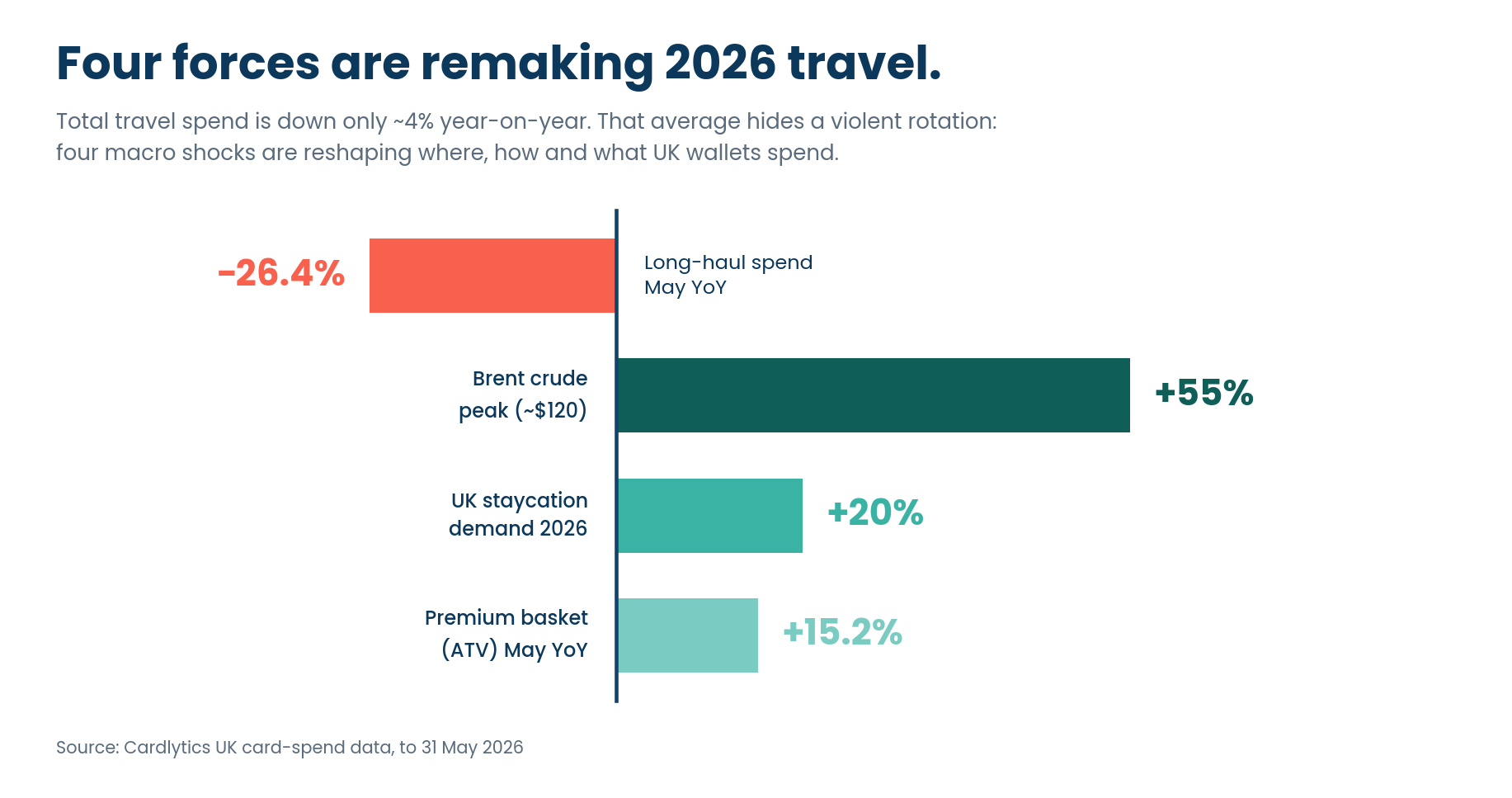
UK travel spend looks steady on the surface — down just ~4% year-on-year. Look closer, and the story isn't decline. It's rotation.
New analysis from Cardlytics, drawing on UK card-spend data to the end of May 2026, shows four macro shocks — the US–Iran conflict, a jet-fuel supply squeeze, a staycation surge, and a resilient premium wallet — quietly redrawing where, how and what UK travellers book.
Four shifts travel leaders shouldn't ignore
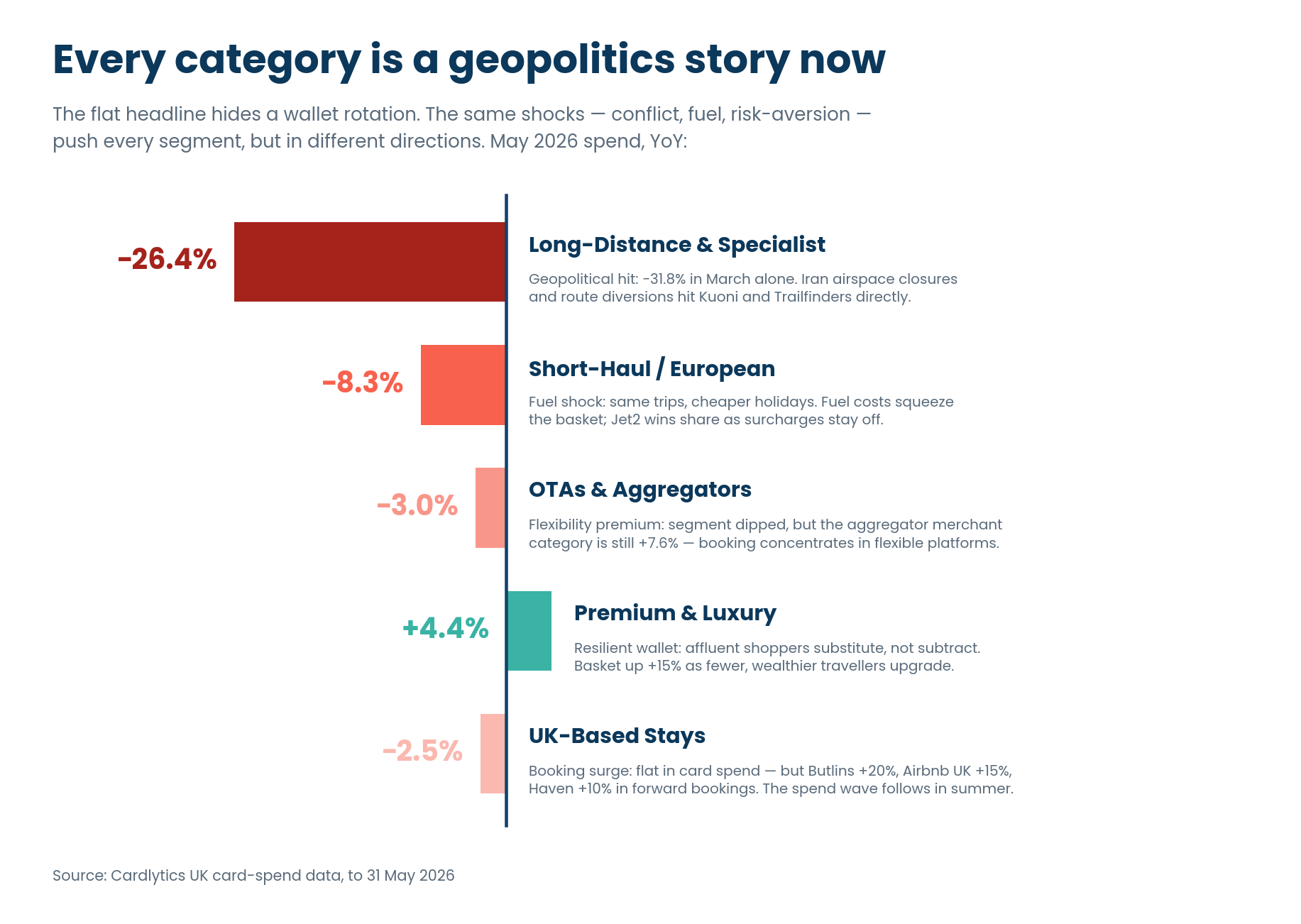
Long-haul is falling off a cliff. Long-Distance & Specialist spend fell 26.4% in May year-on-year — but trips fell 29.4%. Nearly a third of journeys are gone, and rising ticket values are masking a real, geopolitically-driven pullback.
Booking is moving to the middlemen. The travel aggregators and agencies category grew 7.6% while tour operators fell 10.1% and cruise lines 9.8%. Facing an uncertain
backdrop, consumers are paying a premium for flexibility — booking through platforms they trust to find value and re-route them.
Premium travellers substitute — they don't subtract. Premium & Luxury spend rose 4.4%, with the average basket up 15.2%. Fewer, wealthier travellers are trading up, and luxury domestic stays are absorbing displaced long-haul demand.
The staycation wave hasn't hit the card data yet. UK domestic demand is up around 20% year-on-year, with 46% of Brits citing global conflict as a reason to holiday at home. Forward bookings are surging — the spend wave lands this summer.
Unlock the full State of Spend: Travel Edition
The headline numbers hide the real story: a collapse in long-haul trips, a flight to flexible booking, and a premium wallet that refuses to slow down. Download the full report for the segment-by-segment breakdown and four travel plays for a cautious wallet.
Inside the report:
- The Long-Haul Cliff: why trips fell nearly 40% in March — and what rising
ticket values are hiding. - Same Shift, Five Behaviours: spend decomposed into trips and basket size, from mass desertion to trading up.
- Where Spend Flows: the merchant categories gaining and losing share as booking concentrates with aggregators
- Four Travel Plays: where Card-Linked Offers and Cardlytics Insights should focus for OTAs, long-haul operators, premium brands and short-haul carriers.


Four signals from a shifting wallet — and what they mean for advertisers.
UK consumer spending looks healthy on the surface. Look closer, and the wallet is quietly diverging.
New analysis from Cardlytics, drawing on UK purchase data across more than 60 million enabled accounts, shows positive year-on-year spend growth across every macro category in H1 2026. But transactions, customer counts, and basket sizes tell a very different story underneath.
Consumers are protecting holidays, paying more for fewer nights out, and trading down on the high street.
Three shifts leaders shouldn't ignore
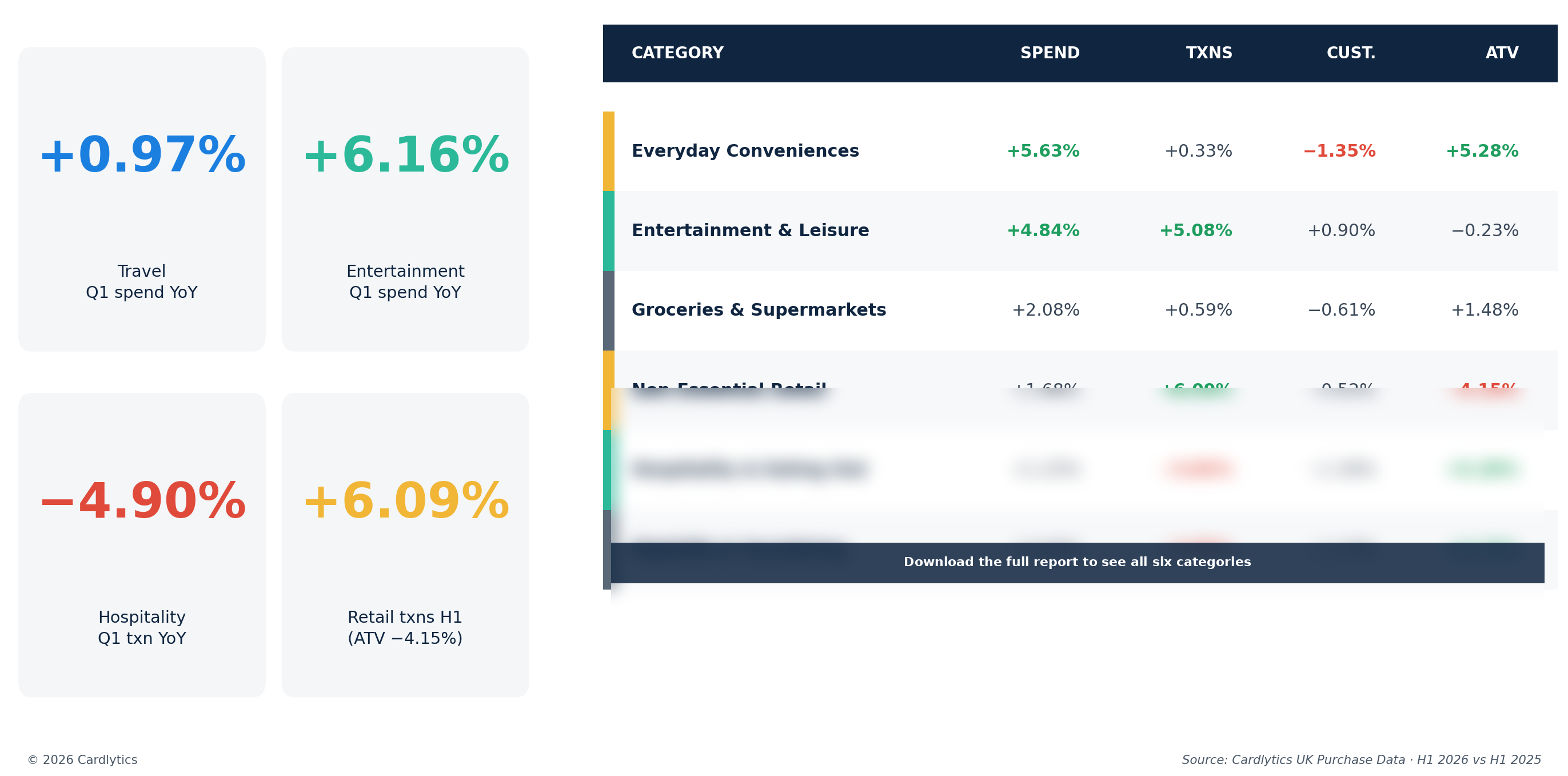
Holidays held, but restaurants didn't. Hospitality lost 3.83% of transactions year-on-year in H1; Nightlife lost 3.95%. Travel grew 0.97% in Q1, with Entertainment & Leisure up 6.16%.
Inflation is doing the heavy lifting on the high street. Hospitality, Nightlife, and Everyday Conveniences all posted positive spend growth — but only because average ticket value rose around 5%. Real visit frequency is falling.
Retail is winning volume and losing value. Non-Essential Retail transactions rose 6.09% in H1 while average basket size fell 4.15%. Consumers are shopping more often and spending less per basket — a clear discount-led signal.
Spend and transactions tell two different stores
Unlock the full Q2 State of Spend report
Top-line growth is masking a structural pullback in mid-week dining, a narrowing active customer base, and a discount-driven retail shift. Download the full report for the category-by-category breakdown and the four advertiser playbooks for an uneven wallet.
Inside the report:
- The "Who Is Losing?" Index: How six macro categories really performed once ATV inflation is stripped out.
- The Hospitality & Nightlife Squeeze: Why footfall is down ~4% even as spend ticks up.
- The Retail Paradox: Record transaction frequency colliding with shrinking baskets.
Four Playbooks for Advertisers: Where to drive frequency, where to grow basket size, and where loyalty beats acquisition in Q3.

From loyalty to relevance: Why personalised rewards matter more than ever for UK banks
UK consumers may feel loyal to their bank, but that loyalty is increasingly conditional.
New research from Cardlytics, based on a nationally representative survey of 4,000 UK adults, shows that while most customers are not actively planning to switch, many are open to reassessing where they bank when the value is clear.
Two thirds of consumers (65%) say they feel loyal to their main bank, and 60% say they are unlikely to switch in the next 12 months. But that stability should not be mistaken for permanence. More than half (57%) have switched their main bank account at some point as an adult, and many now spread their money across more than one provider.
The result is a banking market where retention is no longer just about keeping customers from leaving altogether. It is about staying relevant in more of their everyday financial decisions.
Trust and service still matter, but they are now the baseline
When asked what keeps them with their current bank, UK consumers are most likely to cite good customer service (40%), brand trust and reputation (35%), and the quality of mobile or online banking (32%).
These are the foundations of a strong banking relationship. They help explain why customers stay put, particularly older generations. For example, Baby Boomers are significantly more likely to say customer service is a key reason they stay with their bank (50%).
But these factors are increasingly expected. They are essential to retention, but on their own they may be less effective at creating real competitive advantage.
Unlock the full Cardlytics Banking Index 2026
The shift from passive loyalty to active relevance is changing how the UK banks. To read the full analysis on how financial value triggers action, the impact of personalised rewards on 18 to 34 year olds, and why loyalty is no longer exclusive, download the complete report below.
Get the full insights to discover:
- The Switching Triggers: The specific financial incentives driving 25% of Gen Z to reconsider their bank.
- The Personalisation Opportunity: How tailored rewards can increase retention by up to 55% for key demographics.
- The Visibility Challenge: Why 22% of customers are unaware of the rewards their banks already offer.
- Multi-banking Trends: Why customers are spreading their finances and how to capture a greater share of wallet.